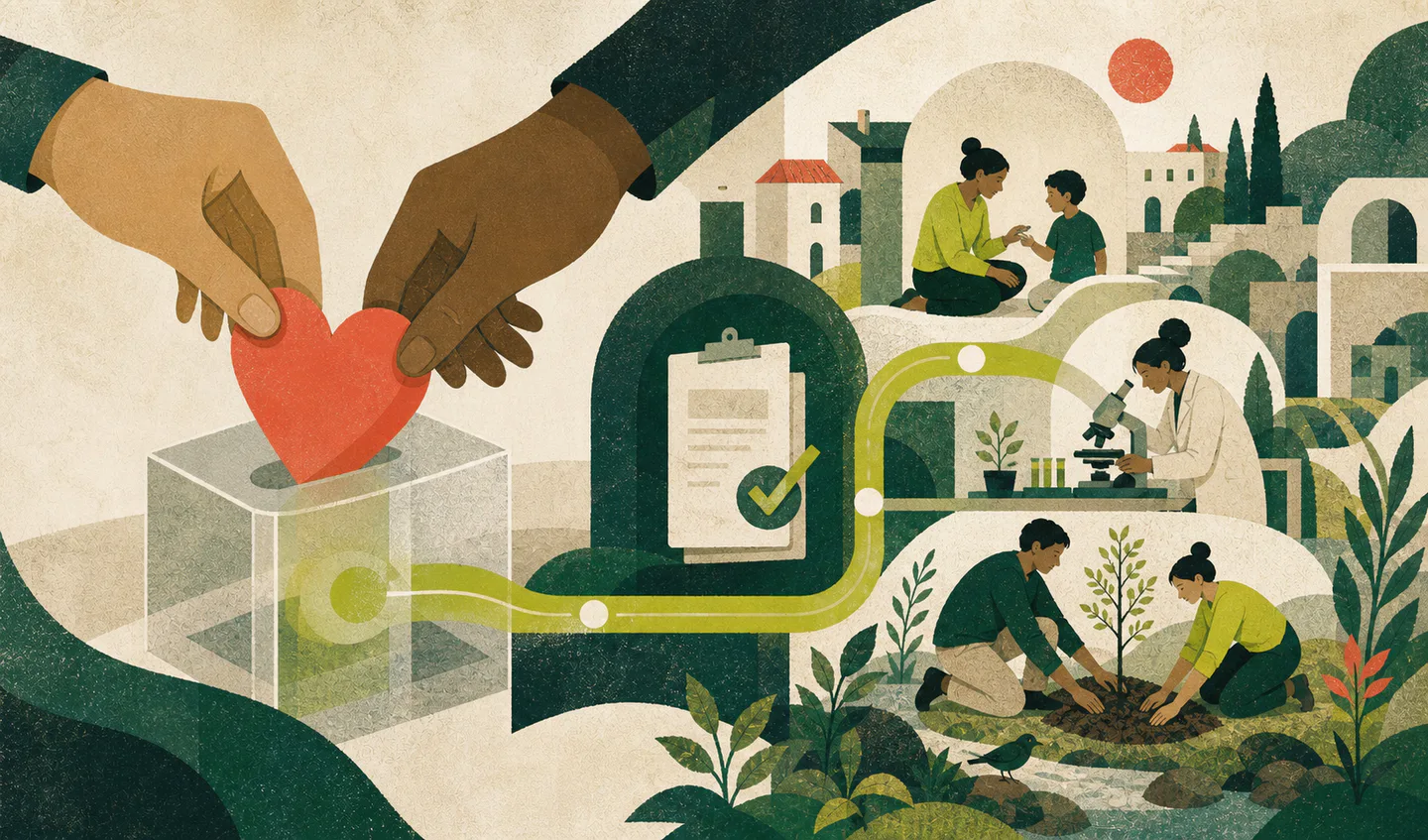
You open your phone and find an appeal: an emergency, a striking photograph, a link that lets you donate in two taps. It is the moment when you are at your most generous — and exactly the moment when it is easiest to send your help to the wrong place. Donating well does not mean giving less or mistrusting everyone. It means making sure the money reaches where it is needed, avoiding traps and, when you are entitled to it, recovering part of what you gave. A few checks are enough; this guide puts every one of them in order.
Before emotion, take two minutes
The best donations grow from a genuine interest, not the impulse of a moment. Emergencies in particular — an earthquake, flood or humanitarian crisis — invariably attract improvised or openly fraudulent fundraisers that exploit haste and generosity precisely when scrutiny is lowest.
The golden rule: if a request is too urgent to allow you two minutes to check it, it is too urgent to trust.
If the cause is real, two minutes change nothing; if it is a scam, those minutes may reveal it. A broader principle applies too: a considered donation, perhaps smaller but directed to an organization you chose carefully and can support over time, is worth more than a large impulse gift you later regret or whose outcome you never learn.
Does the organization really exist? Check RUNTS
The first check is objective. RUNTS — Italy’s Single National Register of the Third Sector — is public and free for anyone to consult through the organization search, by name or tax code. It tells you whether you are dealing with a registered Third Sector Entity, with a public status, articles of association and specific transparency duties — while remembering that an association can be perfectly serious without being registered with RUNTS. If you are starting from scratch, the NonProfit.it directory is a useful first step: it brings organizations together and lets you filter by cause, region and city, so you can find and compare them before moving to the organization’s official channels.
NonProfit.it helps you find and compare organizations. To donate, verify a tax code or allocate your 5x1000, always use the organization’s official website or the official lists required by law.
What to look for in the register
When you search RUNTS by name or tax code, you find the exact legal name, tax code, register section, registered office and declared activity of general interest. In a couple of minutes you can establish two things: that the organization appears in a public register and that the information shown in its campaigns matches the official record.
Watch out for look-alike names. Copying a well-known organization’s name while changing one word, abbreviation or letter is a classic way to borrow its credibility. The only detail that identifies an organization uniquely and verifiably is its tax code, not a name that merely “sounds right”. Always check that the tax code and contact details belong to the organization you intend to support.
Use a traceable method — and keep the receipt
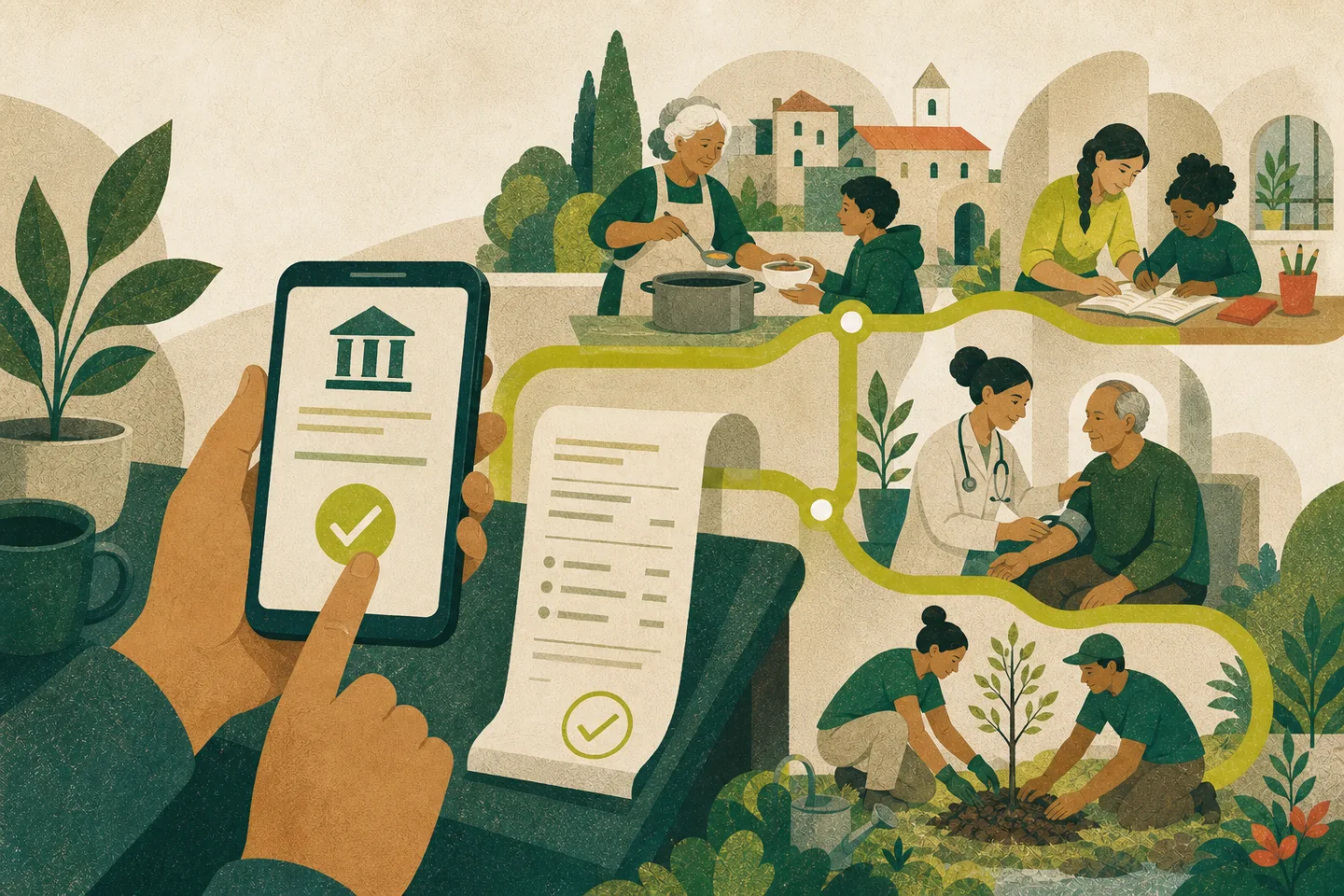
Bank or postal transfer, credit or debit card, postal payment slip, cheque, or a recognized digital payment system: use a traceable method and avoid cash. Traceability protects you by leaving documentary evidence of what you paid and to whom, and without it no tax relief is possible. Cash donations may still help the organization, but they give you no entitlement and leave no trail. Always keep the receipt or confirmation email: it is the document you need for your tax return and in the event of checks.
Tax credit or income deduction: what changes for you
Cash donations to Third Sector Entities generally qualify for tax relief through one of two different routes.
IRPEF tax credit | Deduction from taxable income | |
|---|---|---|
How it works | Directly reduces the tax due | Reduces the income on which tax is calculated |
Amount | 30% of the gift (35% for ODV), within an annual limit | Up to 10% of total declared income |
Usually best for | Smaller amounts, provided sufficient tax is due | Higher incomes and substantial donations |
The tax credit is a direct reduction of tax and is particularly advantageous for smaller donations. The income deduction instead removes a portion of income that may otherwise be taxed at higher rates, and therefore tends to benefit higher incomes. Generally, you use only one of the two for the same donation. Amounts and limits can change from year to year: before relying on a precise figure, check the current rules with the Italian Revenue Agency or an accountant. This page explains the mechanism; it is not professional advice.
Your donation may appear in the pre-filled tax return
With the Third Sector reform fully in force, from 2026 it becomes even more important to give the organization accurate personal details, especially your tax code, and retain proof of payment. Traceable cash gifts made by individuals and linked to the donor’s tax code can be reported by the organization to the Italian Revenue Agency for the following year’s pre-filled return. This does not remove your duty to check: pre-filled data must always be verified, and if an item is missing or incorrect your own documentation — receipt, bank-transfer record or bank statement — remains decisive.
There is a privacy aspect too. The organization must process your data correctly, and you can object to its use for the pre-filled return in the ways provided by the Revenue Agency. That is another reason to donate through official channels, enter your details accurately and always retain the receipt.
Beyond a bank transfer: goods, legacies and platforms
Giving goods instead of money
Many organizations accept in-kind donations — equipment, materials or food — which in some cases may also qualify for tax relief, under specific rules for valuing the asset. Always agree an in-kind gift with the organization first. You need to know that what you offer is genuinely useful and can be managed properly; otherwise you risk handing it a cost rather than help.
A charitable gift in a will
Leaving part of your estate to a nonprofit organization in your will is an often-overlooked form of giving. It does not affect what you have available during your lifetime and, while respecting the shares Italian law reserves to family members, allows you to leave a lasting mark. Many organizations have a dedicated legacy contact who can explain how it works; for the legal drafting, consult a notary.
Fundraisers and platforms: who manages your money?
Crowdfunding, social-media campaigns and intermediaries collecting for third parties are legitimate and often effective tools, but they add a step between you and the beneficiary — and therefore one more thing to check. Before contributing, ask: is the recipient organization clearly named and identifiable? Does the platform retain a fee, and how much? Will the whole amount reach the organization, or what proportion will? Serious campaigns disclose this transparently. Be wary of generic personal fundraisers with no recognizable organization behind them, especially those created within hours of a news event.
One-off or recurring?
A one-off gift makes sense in many situations, especially emergencies that need an immediate response. But if you care about a cause over the long term, consider a recurring donation, even a small one.
For an organization, ten euros a month is worth more than one hundred and twenty euros paid once: a predictable flow makes it possible to plan, hire and retain staff, sustain multi-year projects and avoid relying only on campaign peaks.
What happens after you donate
A well-managed donation does not end with payment. A serious organization sends a receipt and, especially if you support a project or give regularly, keeps you informed about how it uses resources through accounts, newsletters or results reports. Over time, this helps you understand whether you chose well.
It is also worth knowing what happens to your data. When you donate, the organization collects personal information and must do so in compliance with privacy law, explaining how and why it processes it. You have the right to know what it retains, to ask not to be overwhelmed by requests and to object to uses you did not authorize. A responsible organization makes this clear from the start rather than hiding it at the bottom of a form.
Recognizing a suspicious request
Common warning signs include excessive urgency (“donate now or it will be too late”); payments accepted only in cash or through untraceable channels; a vague mission consisting entirely of emotion with no concrete explanation of how money will be used; no accounts or verifiable information; unsolicited contact from an organization whose name closely resembles a familiar one; and donation pages with suspicious addresses or no secure connection. No single sign proves fraud, but the more of them you see together, the wiser it is to investigate before paying rather than afterwards.
A typical case: within hours of a disaster, dozens of appeals appear. A name almost identical to a well-known organization, payment only by top-up or cryptocurrency, and no accounts are three warning signs that together are enough reason to stop.
Digital scams — and street fundraisers
Most fraud now takes place online. Donate only through official channels reached by typing the address yourself or starting from a reliable source, never through a link received by email, text message or social media. Check the page address before entering any data: fake pages are often nearly perfect copies with only one incorrect detail in the URL. Be wary of social profiles that imitate known organizations and collect through private messages, and of appeals asking for gift cards, cryptocurrency or phone credit. No serious organization raises funds that way.
The same applies to street and door-to-door fundraising. Genuine representatives exist, but so do impostors. A legitimate fundraiser can be identified, displays recognizable signs of the organization, carries information, does not rush you and does not demand sensitive data or cash without a receipt. If in doubt, note the organization’s name and donate independently through its official channels. A real cause will still be there tomorrow.
Once you have checked the organization and chosen how to give, the act itself is simple and safe. If you still do not know whom to support, start there: in the NonProfit.it directory you can find and compare organizations by cause, region and city, then reach the organization’s official website from its profile and donate safely using the correct details. To learn how to distinguish an organization that truly deserves your support, read the guide to choosing an organization.